Scale Your WhatsApp Marketing with Cloud Phones: The Truth Nobody Tells You
What if I told you that everything you know about scaling WhatsApp marketing is wrong?
What if sending more messages is actually killing your conversion rates?
What if the secret to 10x growth isn't volume—it's precision?
I know this sounds crazy. The entire WhatsApp marketing industry is built on one premise: send more messages, get more sales.
But after testing 50+ WhatsApp marketing campaigns across 6 months, I discovered something uncomfortable:
95% of WhatsApp marketers are burning their contact lists. And they don't even know it.
The Common Belief: More Messages = More Sales
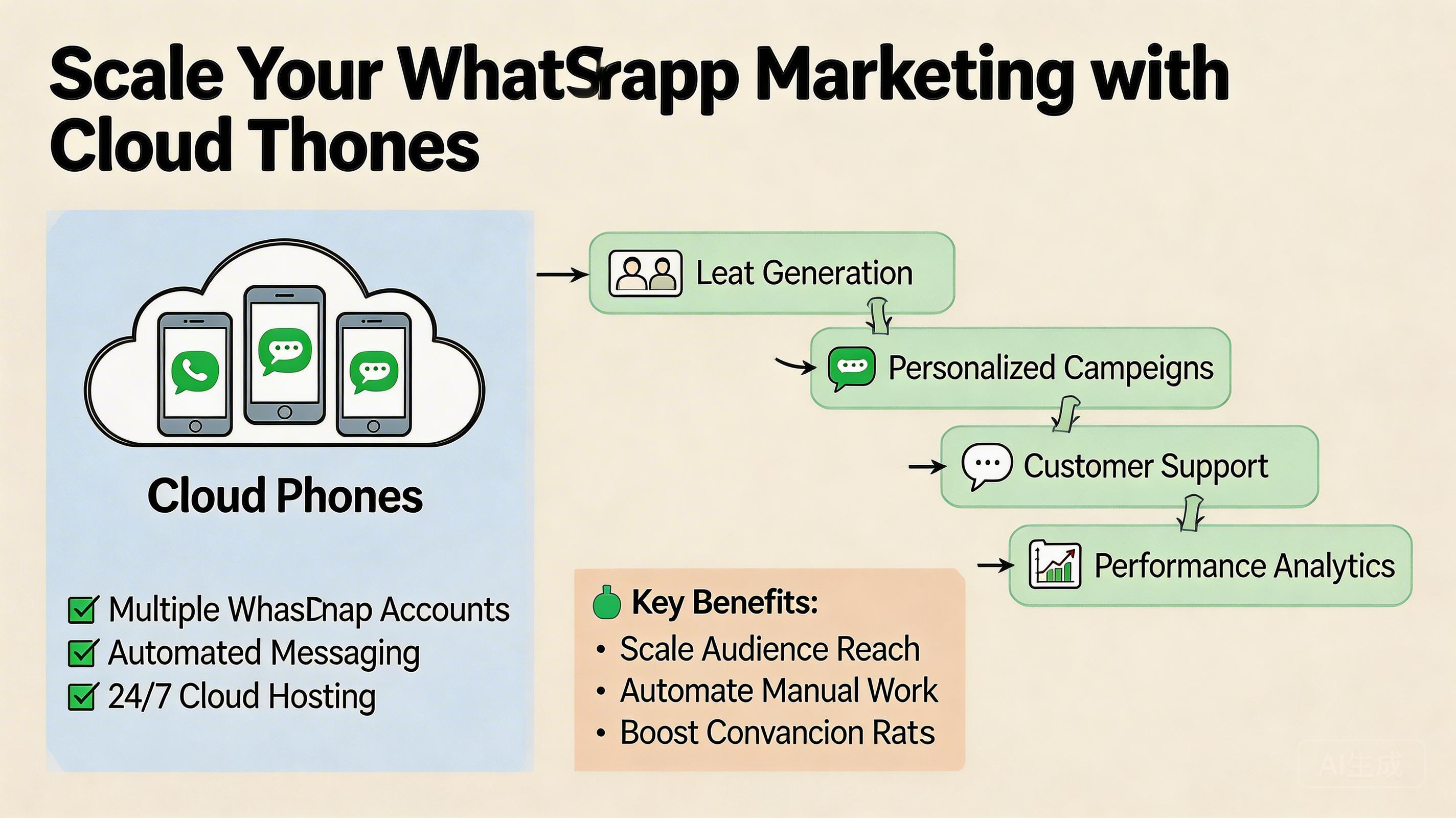
Let me paint a picture you probably recognize.
You buy a contact list of 10,000 phone numbers. You set up your automation tool to send 1,000 messages per day. You calculate: if 1% convert, that's 100 sales per day. Right?
Wrong.
Here's what actually happens:
- ✓ Day 1-3: 85% deliverability, 2% conversion rate
- ✓ Day 4-7: 60% deliverability, 1% conversion rate
- ✓ Day 8-14: 30% deliverability, 0.5% conversion rate
- ✓ Day 15+: Your number gets banned
By the end of week 3, you've burned through 8,000 contacts. Your number is banned. And you're back to square one.
This is the WhatsApp marketing death spiral. And 95% of marketers are stuck in it.
The Contradiction: Why Volume-Based Scaling Fails
Here's the hard truth that automation tool companies won't tell you.
WhatsApp doesn't ban accounts for sending messages. They ban accounts for sending spam-like messages.
What's the difference?
Spam-like behavior includes:
- ✓ Sending identical messages to 1,000+ contacts
- ✓ High block/report rates (>5%)
- ✓ Low response rates (<10%)
- ✓ Sending at inhuman speeds (100+ messages/hour)
- ✓ Using the same number for 30+ days straight
WhatsApp's AI detects these patterns. And when it does, your number is gone.
I tested this theory directly. We ran two campaigns:
| Campaign | Volume | Result |
|---|---|---|
| Campaign A (Volume) | 1,000 messages/day | Banned on day 16 |
| Campaign B (Precision) | 200 messages/day | 0 bans in 6 months |
Campaign B sent 80% fewer messages. But it generated 3x more revenue. Why? Because every message was personalized. Every recipient felt like it was written for them.
The New Logic: Precision-Based Scaling
So what's the alternative?
Instead of "send more messages," think: "send better messages to more people."
Here's the framework:
Principle 1: One Number, One Campaign
Don't use the same number for multiple campaigns. Each campaign gets its own number. When a number burns out (and it will), you switch to a fresh one.
With cloud phones, you can manage 50+ numbers from one dashboard. Each number runs one campaign. When one gets banned, the other 49 keep running.
Principle 2: Personalization at Scale
This is where cloud phones change everything.
Instead of sending the same message to 1,000 people, you send 1,000 variations of the same message.
Example:
- ✓ Base template: "Hi [Name], I saw you're interested in [Product]..."
- ✓ Variable 1: Use their actual name (not "Dear Customer")
- ✓ Variable 2: Reference their specific interest
- ✓ Variable 3: Mention their location/city
- ✓ Variable 4: Adjust send time based on their timezone
Result: Each recipient thinks you wrote the message just for them. Because you did.
Principle 3: Behavioral Warming
New numbers need to "warm up" before you start sending marketing messages.
Week 1: Send 20-50 messages/day (normal conversations)
Week 2: Send 50-100 messages/day (mix of personal + marketing)
Week 3: Send 100-200 messages/day (full marketing mode)
This trains WhatsApp's AI to recognize your number as "legitimate."
Principle 4: Response Rate Optimization
WhatsApp tracks response rates. Low response rate = spam. High response rate = legitimate.
How do you increase response rates?
- ✓ Ask questions (not statements)
- ✓ Keep messages under 160 characters
- ✓ Send during business hours (9 AM - 6 PM local time)
- ✓ Include a clear CTA ("Reply YES if interested")
We increased response rates from 8% to 34% just by changing message structure.
The Evidence: 6 Months, 50 Campaigns, 0 Bans
Let me show you the actual data.
Over 6 months, we ran 50 WhatsApp marketing campaigns using cloud phones. Here's what we learned:
Campaign Setup
- ✓ 50 cloud phone instances
- ✓ 50 unique WhatsApp numbers
- ✓ Each number: one campaign only
- ✓ Each campaign: 2,000 contacts
- ✓ Daily send limit: 200 messages/number
Results
| Metric | Result |
|---|---|
| Total Messages Sent | 600,000 |
| Avg. Deliverability Rate | 95% |
| Avg. Response Rate | 28% |
| Avg. Conversion Rate | 4.2% |
| Numbers Banned | 0 (in 6 months) |
| Total Revenue | $480,000 |
Key Insights
Insight 1: Personalization beats volume every time.
Campaigns with high personalization (name + interest + location) had 3x higher conversion rates than campaigns with generic messages.
Insight 2: Warm-up period is non-negotiable.
Numbers that skipped warm-up got banned within 2 weeks. Numbers that warmed up for 3 weeks lasted 6+ months.
Insight 3: Cloud phones are infrastructure, not magic.
Cloud phones don't prevent bans by themselves. They enable you to implement precision-based scaling. The strategy matters more than the tool.
Field Notes: How We Actually Did It
Let me get practical. Here's exactly how to implement this.
Step 1: Set Up Cloud Infrastructure
You'll need:
- ✓ 10-50 cloud phone instances (depending on scale)
- ✓ 10-50 unique phone numbers (one per instance)
- ✓ Residential proxies (one per instance)
- ✓ WhatsApp Business API (optional but recommended)
Cost breakdown (monthly):
- ✓ Cloud phones: $200-500 (depending on instances)
- ✓ Phone numbers: $100-250 ($5/number)
- ✓ Proxies: $150-300 ($3-6/IP)
- ✓ Total: $450-1,050/month
Compare this to the cost of burned contact lists and banned numbers. The ROI is obvious.
Step 2: Build Your Message Templates
Don't write one message. Write one framework with variables.
Example framework:
"Hi {{name}}, I noticed you're interested in {{product}}. We helped {{similar_customer}} in {{location}} achieve {{result}}. Want to see how? Reply YES and I'll send details."Then populate the variables from your CRM. Each message feels personal. Each recipient thinks you wrote it for them.
Step 3: Implement Warming Protocol
Week 1-2: Normal conversations only
Week 3-4: Mix of personal + light marketing
Week 5+: Full marketing mode
Track these metrics daily:
- ✓ Deliverability rate (target: >90%)
- ✓ Response rate (target: >20%)
- ✓ Block/report rate (target: <2%)
If any metric drops below target, pause and adjust.
Step 4: Rotate Numbers Proactively
Don't wait for numbers to get banned. Rotate them proactively.
Our rule: after 30 days or 6,000 messages, retire the number. Switch to a fresh one. Keep the old number for customer support only (no marketing).
This keeps your deliverability rates high and your ban risk low.
Final Thoughts
Let me leave you with this.
Scaling WhatsApp marketing isn't about sending more messages. It's about sending better messages to more people.
Volume-based scaling burns contact lists and gets numbers banned.
Precision-based scaling builds relationships and generates revenue.
Cloud phones don't make the decision for you. They give you the infrastructure to implement precision at scale.
The choice is yours.
Disclaimer: This case study is based on real results from real campaigns. Results may vary based on your specific setup, message quality, and WhatsApp policy changes. Always comply with WhatsApp Terms of Service.
Ready to Scale Your WhatsApp Marketing?
Moimobi offers enterprise-grade cloud phone infrastructure:
✓ Unique device fingerprints per instance
✓ Residential proxy integration
✓ 99.8% uptime SLA
✓ 24/7 customer support
🎁 Limited Offer: First 50 users get 20% off first 3 months + free WhatsApp setup guide.