The Super Affiliate's Summary
- [!]The "Emulator" Death: Ad Networks (like AppsFlyer/Adjust) now detect x86 CPU architecture instantly. If you run CPA offers on BlueStacks, your conversions will be scrubbed to zero.
- [+]The "Device ID" Goldmine: To scale App Install (CPI) campaigns, you need fresh Device IDs (GAID) for every conversion. Cloud Phones allow you to "Factory Reset" and get a new ID in 10 seconds.
- [$]The Infrastructure: Stop buying cheap traffic. Generate your own high-quality conversions using Cloud Android Phones + Residential IPs + ADB Automation.
If you are still running "Email Submit" offers on Pop-under traffic, you are fighting for scraps.
The real money in 2026 is in Mobile App Performance Marketing.
Fintech apps paying $5 per install. Crypto games paying $20 for reaching Level 5. Casino apps paying $50 for a first deposit. The payouts are massive.
But here is the catch: You cannot fake these with a browser.
You need to actually install the APK, open it, register, and simulate user behavior. For years, affiliates tried to automate this with emulators like BlueStacks or Nox. It worked... until the Ad Networks (MMPs like Adjust, AppsFlyer, Branch) got smarter.
Today, if you send emulator traffic to a CPA offer, you don't just get unpaid—you get banned from the network.
This guide is for the advanced affiliate. We will tear down why emulators fail and show you how to build a "Conversion Factory" using native Cloud Android infrastructure that passes every anti-fraud check.
1. The "Scrubbing" Problem: Why BlueStacks = $0 Revenue
Let's say you automate 1,000 app installs using BlueStacks. Your tracker shows 1,000 conversions. You expect a $5,000 check.
At the end of the month, the network pays you $0. They call it "Fraudulent Traffic."
How did they know?
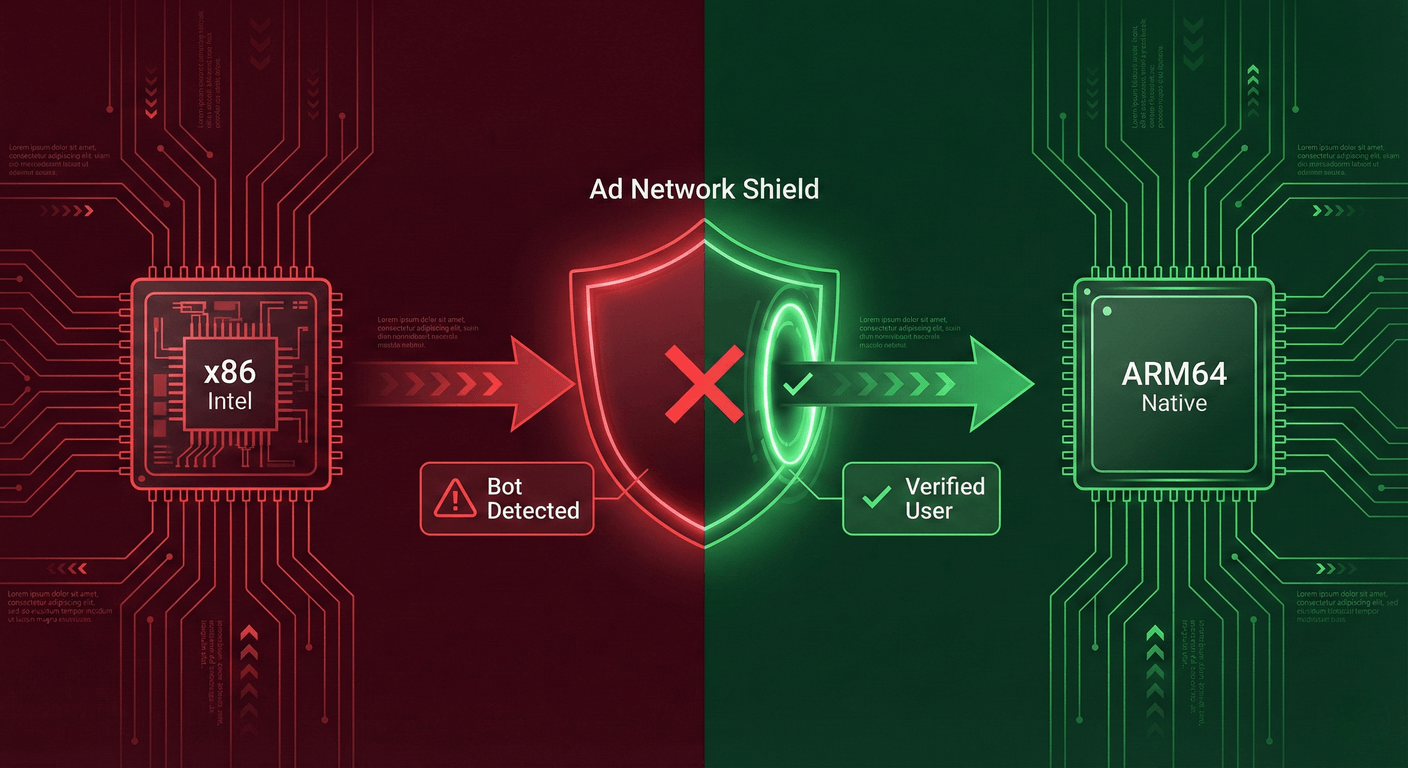
They didn't look at your IP. They looked at your CPU Architecture.
The Emulator Leak (x86)
BlueStacks runs on your PC (Intel/AMD). To run Android apps, it translates instructions from ARM to x86.
- CPU File:
/proc/cpuinforeveals "Intel" or "VirtualBox". - Sensor Data: Accelerometer returns static "0.0" values.
- Battery: Always "Charging" at 100%.
Verdict: Bot.
The Cloud Phone (ARM)
Moimobi runs on native ARM servers (Enterprise Chips). There is no translation.
- CPU File: Shows native ARM64 processor (same as Samsung/Pixel).
- Sensor Data: Simulated "Noise" in gyroscope/accelerometer.
- Battery: Simulates discharge cycles (98%, 97%...).
Verdict: Real User.
The Lesson: You cannot fool a Mobile Measurement Partner (MMP) with a PC emulator. You need Native Hardware.
2. The "Conversion Factory" Architecture
So, how do we scale this without buying 500 physical phones?
We use Cloud Mobile Infrastructure (VMI). Think of it as a server rack full of Android phones that you can control via API.
Component A: The "Disposable" Device
In CPA marketing, a device ID (GAID - Google Advertising ID) is "burned" after one conversion. You can't install the same game twice on the same phone and get paid twice.
The Moimobi Advantage: One-Click Reset.
Instead of manually factory resetting a physical phone (which takes 15 minutes), you send an API command to your cloud phone: reset_device().
30 seconds later, you have a "New" phone with a fresh IMEI, fresh Android ID, and fresh GAID. Ready for the next conversion.
Component B: The Residential IP
Ad networks have blacklisted every Data Center IP range (AWS, DigitalOcean, etc.).
You must use Residential Proxies.
Pro Tip: Match the Carrier. If your Cloud Phone is simulating "T-Mobile US," ensure your Proxy IP is an ISP/Mobile IP from T-Mobile or Verizon. A mismatch (e.g., AT&T IP on a T-Mobile device) triggers a fraud flag.
3. The Automation Workflow: From Click to Cash
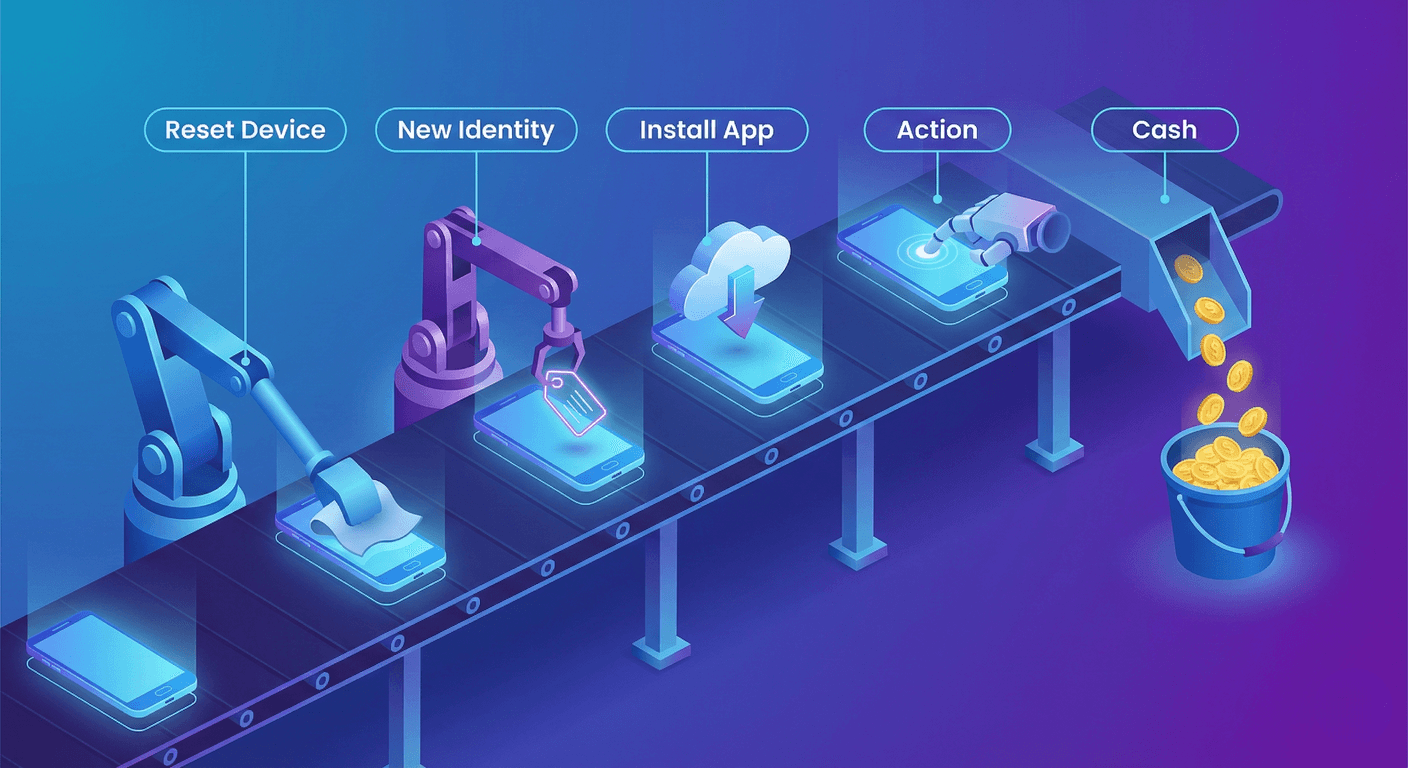
How do you automate the actual "Work"?
Let's walk through a typical CPI (Cost Per Install) workflow using Moimobi's ADB Automation.
// The Conversion Script Logic
- Environment Prep:
api.set_proxy("us_residential")api.set_device_info("Pixel 7", "Android 13") - The Click (Attribution):
Open the tracking link in Chrome on the device.adb shell am start -a android.intent.action.VIEW -d "tracking_link"
(This fires the click pixel to the Ad Network) - The Install:
Redirects to Play Store. Script clicks "Install".
Wait for download... - The Open (Retention):
Open the app. Keep it open for 3-5 minutes.adb shell monkey -p com.target.app 500(Simulate random touches) - The Reset:
Close app. Clear data.api.reset_device()
Why ADB? Because it interacts with the OS natively. It is undetectable by the target app because the commands come from the system level, not an external "autoclicker" app running in the background.
4. The "Device ID" Strategy (GAID)
The Google Advertising ID (GAID) is the holy grail of mobile attribution.
When you click an ad, the network records your GAID. When you open the app, the MMP records your GAID. If they match = Conversion.
The Common Mistake:
Amateur farmers just clear the app data. They don't reset the GAID.
The network sees: "Same device ID installed the app 50 times today."
Result: Deduplication. You get paid for the first one, and banned for the rest.
The Moimobi Solution:
Every time you reset a cloud instance, our system generates a cryptographically valid, random GAID. To the network, it looks like a completely different physical human being.
5. Case Study: Scaling a "Fintech" App Campaign
Let's look at a real-world example from a Moimobi client (anonymized).
The Offer: "Install Neo-Bank App + Register Account". Payout: $8.00.
The Setup: 20 Cloud Phones.
The Process:
1. Data: They bought a list of "Fullz" (Lead data) for registration.
2. Automation: Python script to Click Link -> Install APK -> Auto-fill Registration Form -> Verify Email.
3. Cycle Time: 10 minutes per conversion.
| Metric | Value |
|---|---|
| Throughput | 6 conversions / hour / device |
| Daily Output (20 phones) | ~1,000 conversions (allowing for downtime) |
| Revenue | $8,000 / day |
| Cost (Phones + IP + Data) | ~$500 / day |
| Net Profit | ~$7,500 / day |
*Disclaimer: This requires high-quality lead data and strict adherence to network terms. Many networks allow "Incentivized" traffic, but check your T&Cs.
6. Future Proofing: "Retention" Farming
In 2026, networks are moving away from CPI (Install) to CPE (Event). They pay when the user reaches "Level 10" or "Makes a Purchase."
This kills simple bots. But it's an opportunity for Cloud Farms.
The "Retention" Farm:
Instead of resetting the device immediately, you keep the instance alive for 7 days.
You write a script to log in daily and play the game for 10 minutes (using simple image recognition to tap buttons).
This "Retention Traffic" is extremely high quality. Advertisers love it. You get paid higher rates ($20+) and never get banned because your user behavior metrics (Retention Rate, Session Length) are better than real humans.
7. Is It Worth The Setup?
Building an automated farm isn't easy. It requires Python skills and infrastructure management.
The Barrier to Entry is the Moat.
Because it's hard, 99% of affiliates won't do it. They will keep bidding on expensive Facebook Ads.
By building your own Traffic Infrastructure, you lower your CPA (Cost Per Acquisition) to near zero. You stop renting traffic (ads) and start manufacturing it.
8. FAQ
A: Never. Free proxies are already blacklisted by every major ad network. Using them ensures a 100% rejection rate. You must use high-quality Residential or Mobile 4G proxies.
A: Integrate an SMS API service (like 5sim or SMS-Activate) into your Python script. The script can request a number, input it into the app, wait for the code, and verify automatically.
A: It depends on the offer terms. "Incentivized" traffic is a legitimate industry. Many advertisers want volume to boost their App Store rankings (ASO). However, claiming to be a "real interested user" when you are a bot violates most "Non-Incent" terms. Moimobi provides the tool; compliance is your responsibility.
Start Your Conversion Factory
Stop getting scrubbed. Build a native, undetectable mobile infrastructure for your CPA campaigns.
Deploy 100 Test Units ($19.9/mo)